
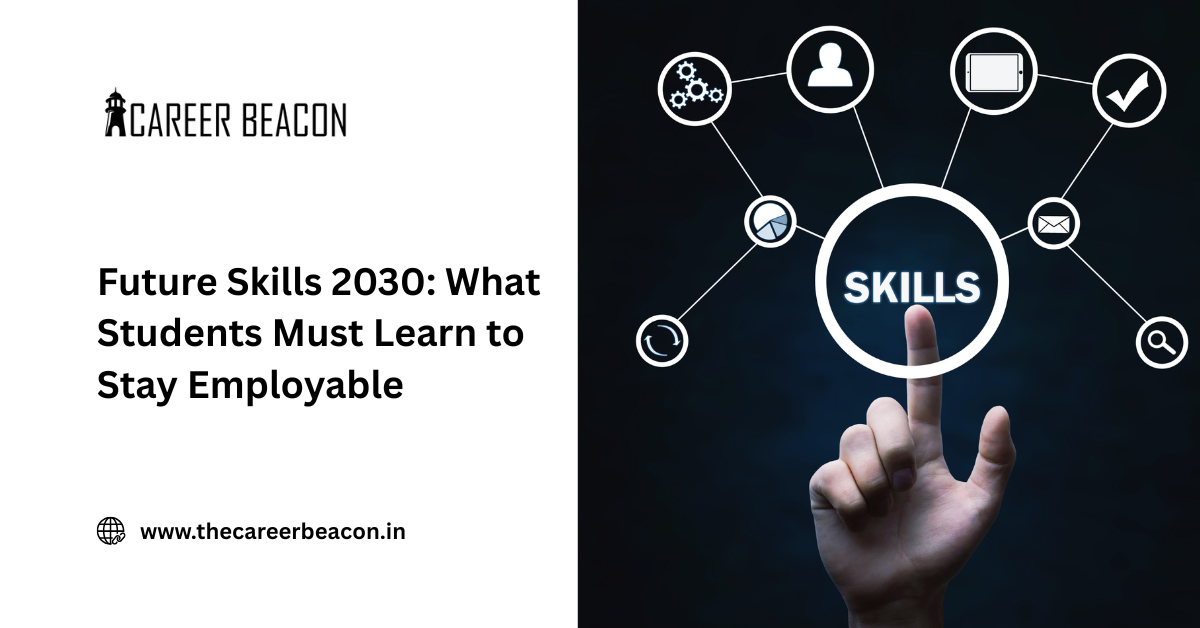
Future Skills 2030: What Students Must Learn to Stay Employable
The world of work is changing faster than ever before. Technologies like artificial intelligence, automation, robotics, data analytics, and digital communication are reshaping every industry. By 2030, many traditional jobs will evolve—or disappear—while entirely new roles will emerge. For students, the biggest challenge is preparing today for careers that may not even exist yet. This makes learning the right future skills essential to stay employable, adaptable, and competitive.
As we move toward 2030, employers will look for people who can think creatively, solve complex problems, work with advanced technologies, and adapt quickly to change. Students who begin developing these abilities early will have a significant advantage in the job market.
Technology-Driven Skills Will Emergence in the Future
One of the primary focus areas for students is to obtain Technology Fluency; this does not mean that all students will become Engineers or Coders but should develop an understanding of how Digital Tools Work, how Data is Used and how Artificial Intelligence is Changing the way Companies make Day-to-Day decisions. Skills such as Basic Programming, Data Literacy, Cybersecurity Awareness and Understanding Digital Platforms are increasingly becoming essential in addition to Traditional Literacy. Everything; every career, whether it is a Finance, Healthcare, etc. Will in some way; shape or form be working with Technology after 2030.
Students who have the capability and capacity to comprehend Data, understand Trends in data and interpret Digital Dashboards will have greater opportunities to make the best Choices out of those alternatives presented to them. Companies rely heavily on Analytics, thus, having Basic Data Knowledge separates students. Technology is the foundation of Future Work, understanding Technology is the Initial Step toward achieving long-term success in a chosen Career.
The future will see increased demand for creativity and problem-solving abilities; these two core competencies cannot be replicated by technological advances.
As technology progresses, it replaces many traditional jobs, but it cannot replicate specific human characteristics such as creativity and the potential for imaginative thinking. As such, employers will increasingly rely upon those workers who possess the ability to invent new ideas, eliminate barriers to collaboration, develop imaginative solutions to business problems, think analytically, and creatively.
To prepare for the future workforce’s needs, students should develop their imagination, engage in collaborative thought processes, encourage open-ended project work, and explore animal, artistic, and entrepreneurial opportunities. In the coming years, creative problem-solving will be one of the most significant skills required by employees. Whether the task involves designing an improved version of a mobile phone application or solving the world’s most complex social challenges, creative problem-solving will remain a crucial aspect of success in the workforce in the foreseeable future.
Communication and Collaboration in a Digital World
In the year 2030, occupation types across the globe will transition into a much larger, more global, remote environment in conjunction with greater interconnectedness of all types of resources. As a direct result of this change, both written communication skills and verbal communication skills will become a primary consideration for job hiring decisions. Students must become proficient at clearly communicating their thoughts and ideas to others, as well as learn to work effectively with team members in a digitally enabled workforce and with the confidence needed to engage and communicate effectively with co-workers through digital means such as video conferencing.
Along with good verbal and written communication skills, emotional intelligence, which includes many different areas such as empathy, perspective-taking, teamwork, conflict resolution, etc., is also of great importance. The ability to manage conflicts in a professional manner, to support team members through their stresses, fears, and frustrations while also maintaining a work-oriented focus will be valuable traits for future employees. As the global workforce continues to evolve into a more diverse and collaborative workplace, these types of interaction skills will increasingly become as valued as technical skills from an employer’s perspective.
Adaptability: The Most Important Skill for 2030
If there’s one skill that will define future success, it is adaptability. With technology constantly changing, students must be willing to learn, unlearn, and relearn throughout their careers. Staying flexible, open-minded, and ready to adjust to new situations is essential.
Adaptable students are the ones who grow with trends, embrace new learning tools, and stay confident even when facing unfamiliar challenges. Whether industries shift or new career paths appear, adaptability will help students stay relevant.
Entrepreneurship and Self-Management
Sustainability and Global Awareness
With climate change and environmental challenges shaping global priorities, students must understand sustainability, ethical decision-making, and global citizenship. Future careers will increasingly require knowledge of green technologies, renewable energy, eco-friendly practices, and sustainable development. Companies are prioritizing social responsibility, and employees with eco-awareness will be in high demand.

 Arabic
 French
 Spanish
 Portuguese
 Deutsch
 Turkish
 Dutch
Dutch
 Italiano
 Russian
 Romaian
 Portuguese (Brazil)
 Greek
Greek